


Building Stronger Teams Through Rhythm: How Drum Therapy and Neurodiversity Coaching Create More Connected, Inclusive, and Resilient Organizations
- stephaniesdrumpart
- 4 days ago
- 4 min read

Strong teams are not built solely through meetings, job titles, strategic plans, or shared goals.
The most successful teams are built through connection, communication, trust, psychological safety, and a sense of belonging.
Whether in corporate environments, healthcare organizations, schools, nonprofit agencies, community groups, or leadership teams, collaboration depends on how well individuals understand themselves and one another.
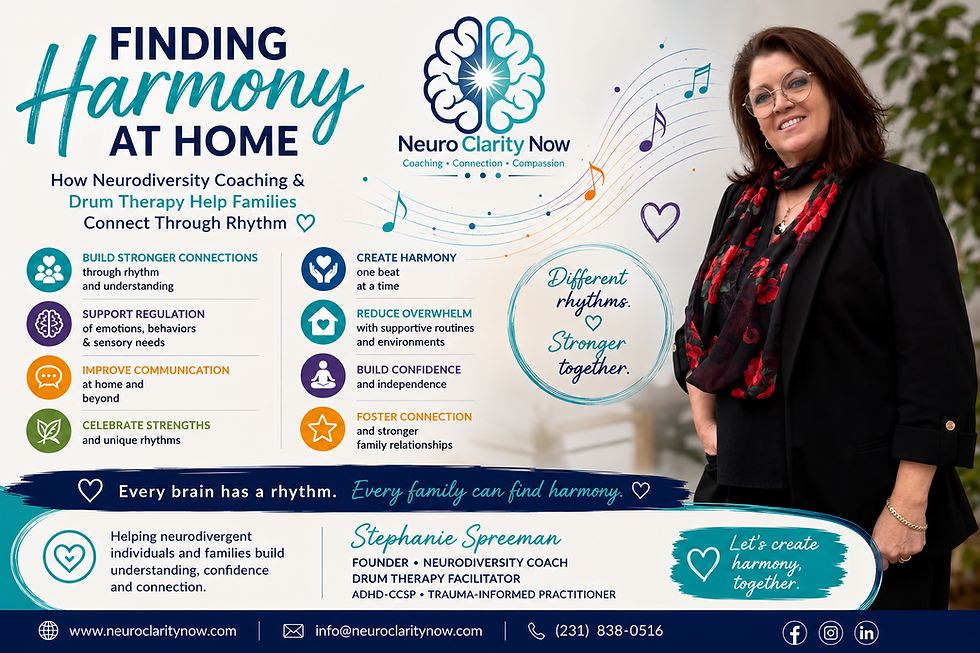
At Neuro Clarity Now, Stephanie Spreeman combines Neurodiversity Coaching and Drum Therapy to create engaging, interactive team experiences that strengthen communication, build trust, reduce stress, and help organizations embrace the strengths of diverse ways of thinking.
Why Rhythm Naturally Brings People Together
Long before modern team-building exercises existed, people gathered around rhythm.
Across cultures and throughout history, drumming and percussion have been used to celebrate, communicate, connect, and create shared experiences.
Today, research in neuroscience and music psychology suggests that making rhythm together can support social bonding, improve mood, reduce stress, and strengthen interpersonal connection.
When people participate in a group rhythm experience, something remarkable happens:
Titles disappear
Hierarchies soften
Communication becomes more authentic
People engage as humans first
Rhythm creates a shared experience where every participant contributes to something larger than themselves.
There is no right or wrong way to participate.
Every individual plays a valuable role in creating the collective rhythm.
The Science Behind Rhythm, Connection, and Team Performance
Research has shown that group drumming and rhythm-based activities can positively impact mood, social connection, and stress reduction.
Benefits often include:
Reduced workplace stress and tension
Increased engagement and focus
Improved communication
Enhanced emotional awareness
Greater feelings of connection and belonging
Increased collaboration and teamwork
Rhythm simultaneously engages multiple areas of the brain associated with:
Attention and concentration
Executive functioning
Sensory processing
Motor coordination
Emotional regulation
Social engagement
The repetitive nature of rhythm can also encourage mindfulness and present-moment awareness, helping participants become more engaged with themselves and with one another.
For organizations seeking a meaningful alternative to traditional icebreakers, rhythm-based experiences provide an impactful and memorable solution.
The Role of Neurodiversity Coaching in Team Success
Every team consists of individuals who think differently, communicate differently, solve problems differently, and process information differently.
Those differences are not obstacles.
They are strengths.
Neurodiversity Coaching helps organizations move beyond one-size-fits-all approaches by increasing awareness of:
Different thinking styles
Communication preferences
Sensory needs
Executive functioning differences
Problem-solving approaches
Individual strengths and contributions
Through guided discussions and experiential activities, team members learn to:
Appreciate different perspectives
Improve active listening
Strengthen communication skills
Develop empathy and understanding
Build psychological safety
Navigate conflict more effectively
Create inclusive environments where everyone can contribute
When employees feel understood, respected, and valued, organizations become more innovative, productive, and resilient.
An Experience Everyone Can Participate In
One of the greatest strengths of Drum Therapy is accessibility.
No musical experience is required.
Participants do not need to read music or have any special talent.
The focus is not on performance.
The focus is on participation, connection, and shared experience.
A typical Neurodiversity Coaching and Drum Therapy workshop may include:
Interactive rhythm exercises that encourage teamwork
Call-and-response activities that strengthen listening skills
Leadership and followership experiences
Group challenges that promote collaboration
Discussions around communication styles
Activities that highlight individual strengths
Stress-relieving rhythm experiences that increase engagement and enjoyment
The shared accomplishment of creating rhythm together often leaves participants feeling energized, connected, inspired, and appreciated.
From the Boardroom to the Classroom: A Universal Tool for Connection
Neurodiversity Coaching and Drum Therapy can be adapted for a wide variety of organizations and groups, including:
Corporate Teams and Leadership Groups
Improve collaboration, communication, morale, and workplace culture.
Healthcare Professionals and Caregivers
Support resilience, reduce burnout, and strengthen team cohesion.
Educators and School Staff
Increase understanding of diverse learning styles and improve teamwork.
Students and Youth Programs
Build confidence, communication skills, inclusion, and emotional regulation.
Nonprofit Organizations
Strengthen mission-driven collaboration and community engagement.
First Responders and Service Organizations
Promote stress management, wellness, and connection.
Community Groups and Support Programs
Create belonging, understanding, and meaningful relationships.
These experiences provide far more than entertainment.
They create opportunities for deeper understanding, stronger relationships, and healthier organizational cultures.
Discovering the Rhythm of a Stronger Team
Every successful team has its own rhythm.
Some individuals lead.
Some provide structure.
Some bring creativity.
Some offer stability.
Some inspire innovation.
When every team member is given the opportunity to contribute in a way that honors their strengths, the entire organization becomes stronger.
Neurodiversity Coaching and Drum Therapy help teams discover an important truth:
Harmony does not come from everyone playing the same beat.
Harmony comes from different rhythms working together.
At Neuro Clarity Now, Stephanie Spreeman helps organizations create engaging, inclusive, and transformative experiences that strengthen communication, reduce stress, embrace neurodiversity, and foster cultures where everyone feels valued.
Because the strongest teams are not the ones that sound exactly alike.
They are the ones that learn to create a rhythm together.
Meet Stephanie Spreeman
Stephanie Spreeman is the Founder of Neuro Clarity Now and a Certified Neurodiversity Coach, Certified Drum Therapy Facilitator, ADHD Certified Clinical Services Provider (ADHD-CCSP), and Trauma-Informed Practitioner.
Drawing from both professional expertise and lived experience, Stephanie helps organizations, schools, healthcare teams, and community groups build stronger connections through innovative rhythm-based experiences and neurodiversity-informed coaching.
Her mission is to help people better understand themselves and each other so they can communicate, collaborate, and thrive together.
Ready to Strengthen Your Team?
Whether you lead a business, healthcare organization, educational institution, nonprofit agency, or community program, Neurodiversity Coaching and Drum Therapy offer a unique and impactful way to improve communication, increase engagement, and build stronger teams.
Contact Stephanie Spreeman
Schedule a Discovery Call to learn how customized team-building experiences can help your organization improve communication, foster inclusion, and create a culture where every voice matters.
Every Team Has a Rhythm. Every Voice Matters. Every Contribution Counts.
Let's build a stronger rhythm together.


Comments